
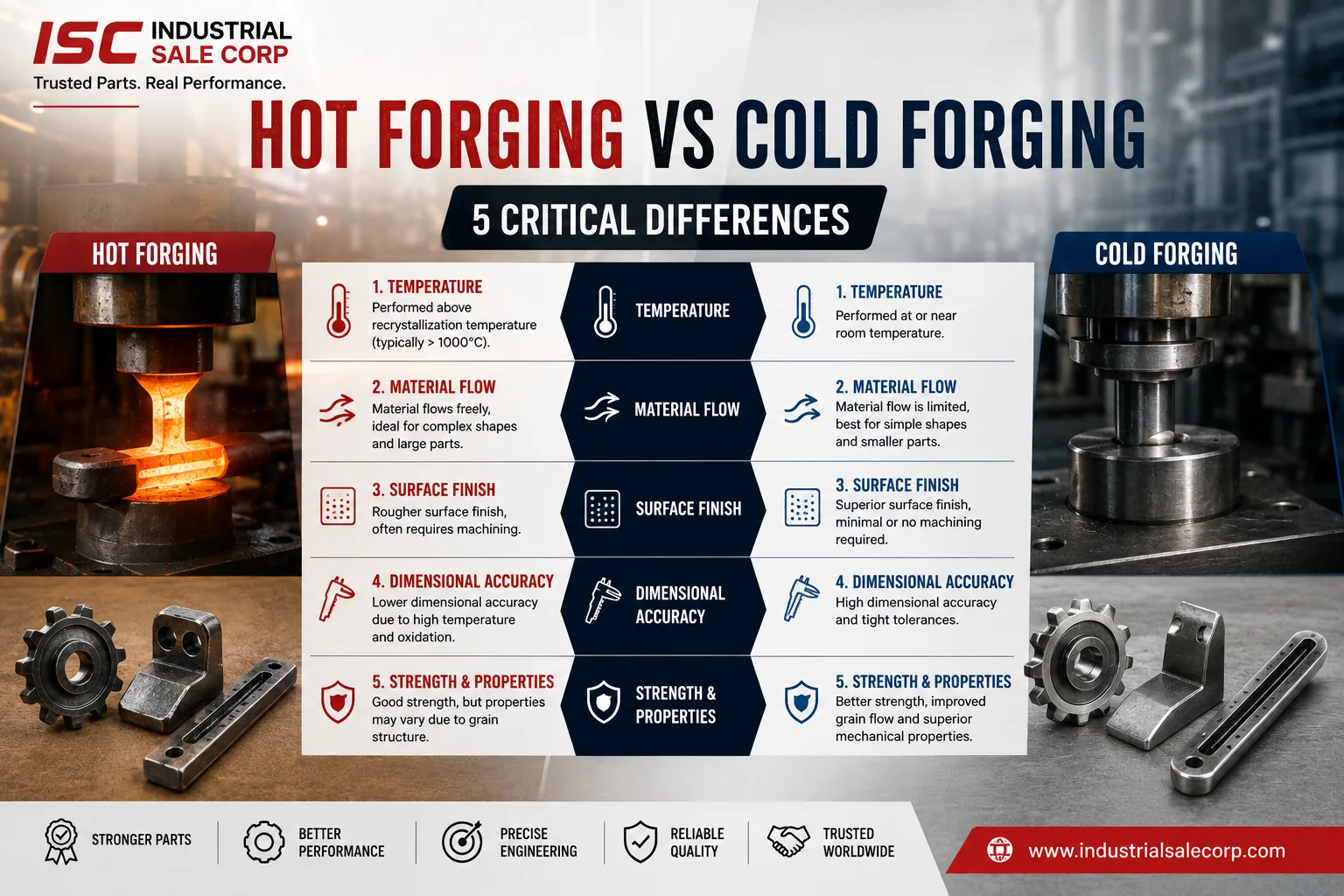
Every buyer of agricultural spare parts eventually asks about hot forging vs cold forging — usually after wondering why two suppliers quote wildly different prices for what looks like the same part. The two processes produce genuinely different mechanical properties, and the answer says more about expected service life than either quote does.
📋 In This Guide
Hot Forging vs Cold Forging: Side by Side
| Factor | Hot Forging | Cold Forging |
|---|---|---|
| Working temperature | 1,100–1,250°C | Room temperature |
| Grain structure effect | Refined, follows part shape — better fatigue resistance | Preserved, surface strain-hardened |
| Achievable complexity | Complex profiles (rasp bars, blades, guards) | Simpler, smaller shapes |
| Dimensional tolerance | Wider, often needs secondary machining | Tighter, straight out of the die |
| Surface finish | Shows scale, needs finishing | Smoother as-formed |
| Best suited for | Large, high-impact parts | Small precision fasteners and fittings |
What Happens During Hot Forging
Heating steel above its recrystallization temperature lets it deform easily under pressure, which allows complex shapes like rasp bars, hammer blades, and knife guards to be formed in a single strike without cracking. This is the deciding factor in the hot forging vs cold forging choice for anything that takes repeated impact in the field.
What Happens During Cold Forging
Cold forging shapes steel at or near room temperature using high pressure instead of heat. It holds tighter tolerances and a smoother finish but is limited to simpler geometries — which is why it rarely shows up in the high-wear components that fail first on a combine harvester.
Which Process Suits Which Agricultural Parts
For parts that absorb repeated high-impact loads — hammer blades, rasp bars for combine harvesters, knife guards, and sprockets — hot forging is the standard, because the refined grain structure directly improves fatigue life under shock loading. Cold forging tends to show up in smaller precision fasteners rather than the components most likely to fail during a harvest.
Ask your supplier directly: which process they use for each part category, and why. A supplier confident in the hot forging vs cold forging trade-offs should explain the choice in terms of the part’s load conditions, not just cost.
FAQ
Is hot forging vs cold forging a question of quality, or just application?
Mostly application. Neither process is universally “better” — each suits different part geometries and load conditions.
Are hot-forged parts always stronger than cast parts?
Generally yes for parts under repeated impact, because forging aligns the grain structure with the part’s shape rather than leaving it random, as casting does.
Does hot forging cost more than cold forging?
It depends on part size and volume — hot forging is often more economical for larger, high-impact components, while cold forging can be cheaper at scale for small precision parts.
Buyers evaluating a forging supplier for high-wear agricultural parts should ask specifically which process is used for each part category. Industrial Sales Corporation hot-forges rasp bars, hammer blades, and knife guards for exactly this reason.