
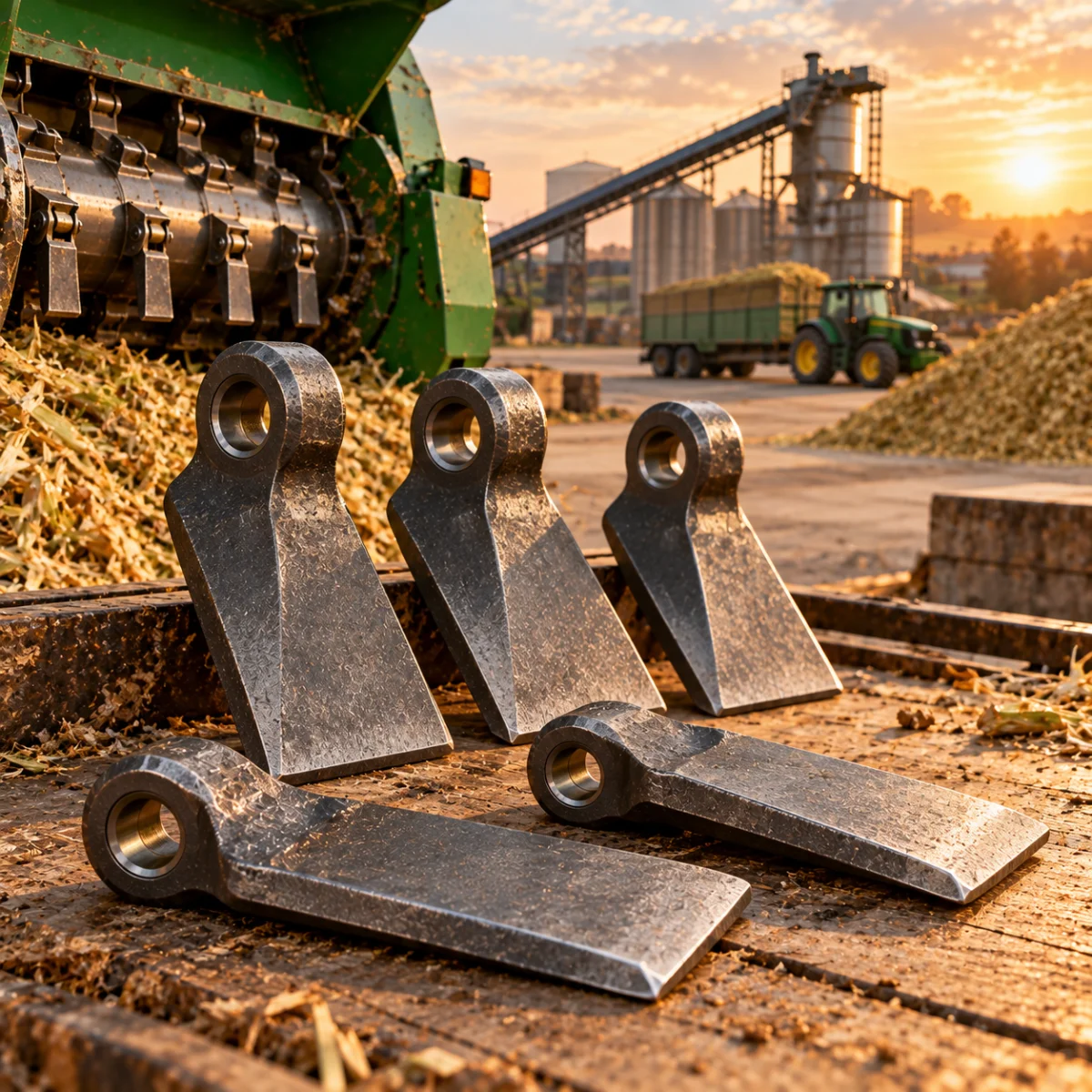
European forage and biomass processors running hammer mills and flail-type harvesters go through hammer blades faster than almost any other wear part on the machine — especially when processing tough stalk material or recycled wood waste. Finding a hammer blades supplier Europe processors can reorder from without a six-week wait is what keeps a hammer mill running through peak season.
This guide covers what hammer blades do, why forging quality matters more than price for this part, what to check before choosing an Indian supplier, and what shipping from India to major European ports looks like.
What Hammer Blades Do and Why Forging Quality Matters
Hammer blades hang loosely on a rotor shaft inside the mill housing and swing outward under centrifugal force, striking incoming material against a fixed screen to reduce particle size. The repeated impact cycle — thousands of strikes per minute at full rotor speed — puts enormous stress on the blade’s leading edge and pivot hole.
A cast hammer blade work-hardens unevenly and tends to chip at the edge under heavy impact; a forged blade has a denser, more uniform grain structure that resists chipping and holds a working edge far longer. For European biomass and forage operations running long seasonal hours, that difference in service life is the main cost factor — not the per-unit purchase price.
Common European Equipment Brands and Hammer Blade Profiles
European hammer mill and forage harvester fleets are more fragmented by brand than South African or North American fleets, which makes exact cross-referencing essential:
- Claas and John Deere. Common across Western and Central Europe on self-propelled forage harvesters — blade profiles vary significantly by machine model and drum width.
- New Holland and Case IH. Widely used on both forage harvesters and stationary hammer mills — hole spacing and blade thickness differ from Claas/John Deere equivalents.
- Independent hammer mill manufacturers. Many European biomass processors run mills from specialist manufacturers rather than the major tractor brands, each with its own blade geometry.
A reliable hammer blades supplier Europe buyers depend on — ideally one familiar with hammer mill operating principles — should confirm the exact mill or harvester model and cross-reference the OEM part number before quoting, rather than selling generic “universal fit” blades.
What to Check Before Choosing an Indian Supplier
| Check | Why It Matters |
|---|---|
| Steel grade and hardness | Ask for a material test certificate per batch — soft blades chip and round off fast. |
| Forged, not cast | Denser grain structure resists chipping under repeated high-speed impact. |
| OEM cross-reference | Blade geometry is model-specific — mismatched fit unbalances the rotor. |
| EU shipping experience | A supplier familiar with EU ports understands realistic transit timelines. |
| Sample order first | The lowest-risk way to validate a new supplier before a full container. |
Practical tip: order hammer blade sets in matched weight sets, not individually. An unbalanced rotor from mixed-weight blades causes vibration that shortens bearing life far faster than normal wear.
Shipping and Lead Times from India to Europe
A typical India-to-Europe shipment for forged hammer blades follows this pattern:
- Production time: 15-25 days for a standard bulk order.
- Port of origin: Most Indian forging exporters route through Mumbai (Nhava Sheva) or Chennai.
- Transit time by sea: 20-30 days to major European ports — Rotterdam, Hamburg, and Antwerp are the most common entry points.
- Total lead time: Most buyers should plan for 5-7 weeks door-to-door from order confirmation to arrival, factoring in customs clearance.
A dependable hammer blades supplier Europe distributors restock from each season should give a realistic, documented lead time upfront.
How ISC Manufactures Hammer Blades
Industrial Sales Corporation (ISC) forges hammer blades at its Ludhiana, Punjab facility using hot-forged alloy steel, heat-treated to the hardness range needed for sustained high-impact service. Every batch is produced against documented steel specifications, and parts are cross-referenced against major European hammer mill and forage harvester models.
ISC has been manufacturing and exporting agricultural forged parts since 1988, and today operates as a dependable hammer blades supplier Europe processors reorder from each season, with an established export process covering documentation, container loading, and freight coordination for Europe-bound shipments.
Cost Advantage: What European Buyers Typically Save
Working with the right hammer blades supplier Europe, distributors and processors sourcing forged hammer blades directly from an Indian manufacturer rather than through a European intermediary typically see meaningful landed-cost savings even after freight, duty, and customs clearance are factored in. For a wear part replaced multiple times per season, that difference compounds significantly across a full year’s restocking volume.
Red Flags to Watch For
- No willingness to share a material test certificate. A genuine manufacturer tests every production batch and keeps records.
- Mismatched blade weights in the same set. Causes rotor imbalance and premature bearing wear.
- Unusually fast quoted lead times with no production detail. Forging and heat-treating steel takes time.
- Reluctance to send a small sample first. This is the lowest-risk way to validate a new supplier relationship.
This post is part of ISC’s ongoing content covering combine harvester and processing wear parts for European importers — see the full blog archive for related guides, including the 3-Point Linkage Parts Supplier Europe guide.
Frequently Asked Questions
How often should hammer blades be replaced?
This varies widely by material processed, but high-abrasion operations often rotate blade sets multiple times per season — inspect for edge rounding and chipping regularly.
Are forged hammer blades worth the extra cost over cast ones?
Yes, in almost all cases. Forged blades hold a working edge significantly longer, which reduces both replacement frequency and machine downtime.
Can I mix blade weights in the same rotor?
No. Mismatched weights cause imbalance, vibration, and premature bearing failure — always install matched sets.
How long does shipping from India to major European ports take?
Most buyers should plan for 5-7 weeks door-to-door from order confirmation to arrival, including customs clearance.
What’s a realistic minimum order quantity?
Most exporters can accommodate a sample order of a few dozen pieces before scaling to a full container load.
Get a Quote
As a hammer blades supplier Europe processors return to season after season, ISC supplies forged hammer blades with OEM cross-reference support. Get in touch for a quote or browse the full product range.