
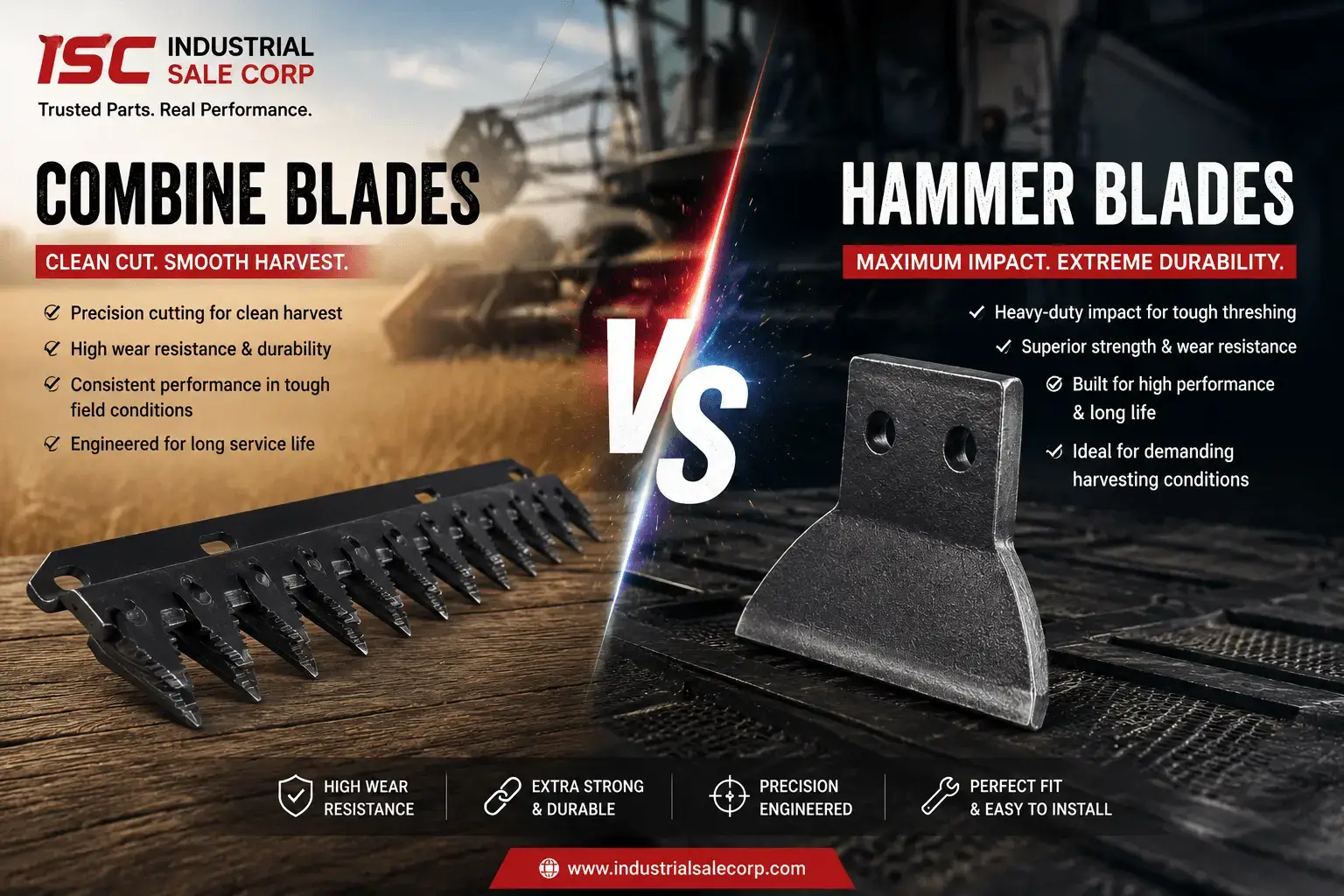
It’s an easy mix-up to make: two parts that look similar in a catalogue photo, ordered off a generic description like “blade,” and only discovered to be wrong once they’re bolted in place. Understanding combine blades vs hammer blades before you order avoids exactly that.
📋 In This Guide
The Quick Answer
| Combine Blades | Hammer Blades | |
|---|---|---|
| Function | Cut by shearing | Separate/chop by impact |
| Location | Header | Threshing or chopper assembly |
| Edge | Sharpened, often serrated | Blunter, impact-resistant |
| Wears at | The cutting edge | Impact face and pivot point |
| Typical steel | Higher-carbon for edge retention | Toughness prioritized over hardness |
What Combine Blades Do
Combine blades typically refer to the cutting components at the header — the knife sections that sever stalks at ground level before crop material enters the machine. These are shearing components with a sharpened, often serrated edge built to cut cleanly through standing crop.
What Hammer Blades Do
Hammer blades sit inside the threshing or straw-chopping mechanism and work by impact rather than shearing — striking crop material to separate grain or chop straw and residue. In the combine blades vs hammer blades comparison, this is the core distinction: shearing versus striking, and it dictates everything else about how each part is built.
Buyer tip: Reference the OEM part number directly rather than a generic “blade” or “knife” listing. A supplier experienced in agricultural forgings should confirm function, not just dimensions, from that number alone.
Ordering the Right Part the First Time
Because the combine blades vs hammer blades distinction comes down to function rather than raw material family, many distributors prefer sourcing both from a single forging partner. A manufacturer experienced in both shearing and impact components for a combine harvester can advise on edge geometry and hardness targets specific to each part’s actual failure mode — and buyers who already source rasp bars for combine harvesters from a given supplier often find it simplifies quality audits to add blade categories to that same relationship.
FAQ
Can hammer blades be used in place of combine blades?
No — the two serve entirely different mechanical functions and are not interchangeable, regardless of similar overall size.
Which wears out faster, combine blades or hammer blades?
Cutting blades at the header generally see more frequent replacement due to direct ground and crop contact, though this varies by crop and field conditions.
Are both parts typically forged from the same steel grade?
Not usually — cutting blades often use higher-carbon steel for edge retention, while hammer blades prioritize impact toughness over edge hardness.
Industrial Sales Corporation forges both cutting blades and hammer blades to OEM cross-reference specs, helping distributors avoid the mix-ups that come from ordering by generic description instead of part number.