
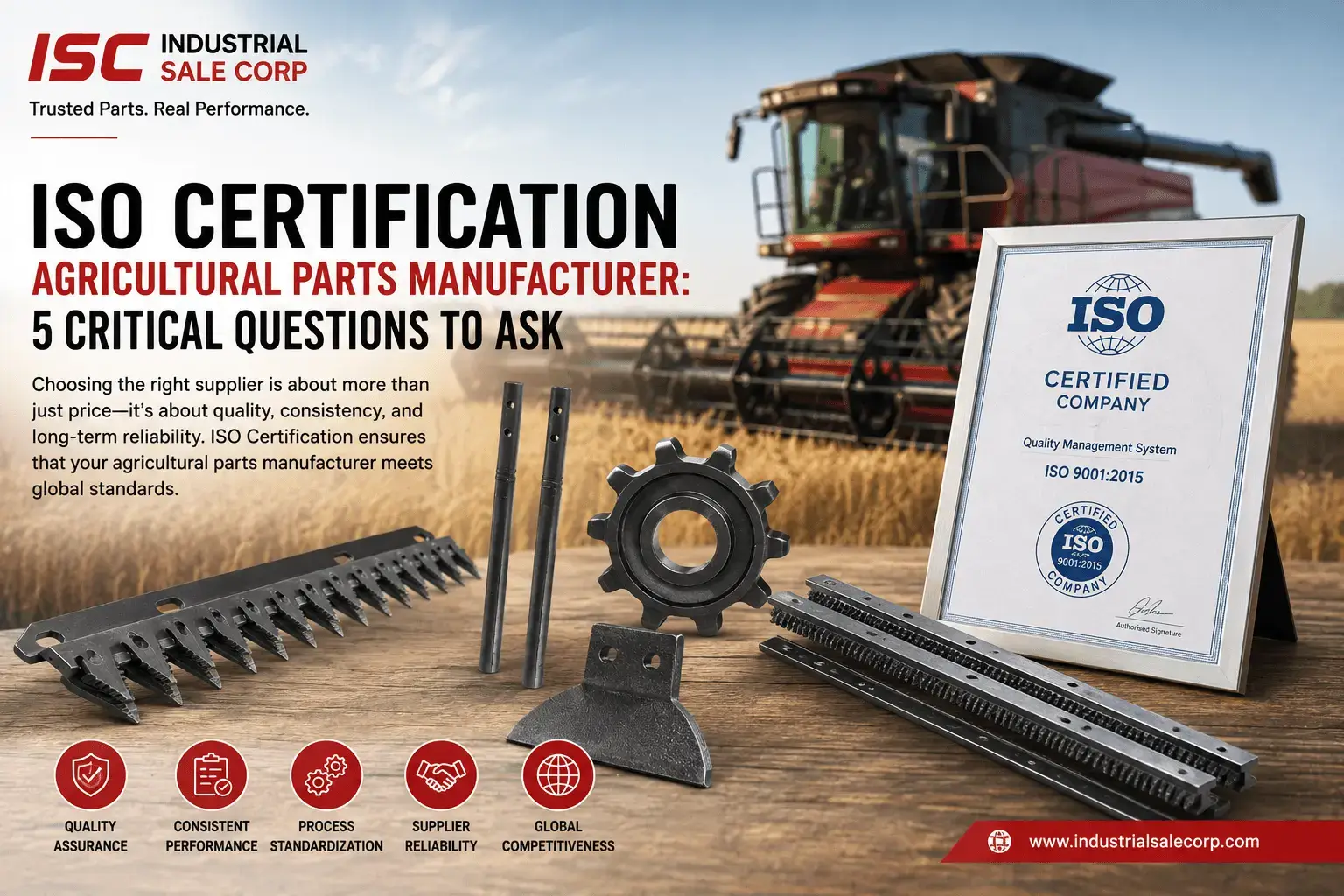
A certificate number on a website doesn’t tell a distributor much on its own. For buyers placing container-volume orders sight unseen, the real question isn’t whether an ISO certification agricultural parts manufacturer has a certificate — it’s what’s actually happening on the shop floor behind it.
📋 In This Guide
Why a Certificate Alone Isn’t Enough
ISO 9001 certification confirms a manufacturer has documented, repeatable quality management processes — but it doesn’t guarantee every batch meets spec on its own. For buyers importing forged parts sight unseen, certification is a starting filter, not a substitute for asking about the specific testing that happens on the shop floor.
The gap between “certified” and “consistently good” usually shows up in the paperwork a manufacturer is willing to hand over without being asked twice. A shop confident in its own process will share batch test reports, material certificates, and hardness readings as a matter of routine — because that documentation is already sitting in a file, generated as part of doing the job right. A shop that hesitates, or offers only the certificate itself, is telling a buyer something about how the rest of the operation runs.
5 Questions to Ask an ISO Certification Agricultural Parts Manufacturer Before You Order
- What hardness testing happens on every batch, and can test reports be shared per shipment?
- Is there material traceability back to the steel supplier and heat number?
- What’s the process for handling an out-of-spec batch — rework, scrap, or ship anyway?
- Can third-party inspection be arranged before container loading, at the buyer’s request?
- How are dimensional tolerances verified against OEM cross-reference specs — sampling or full batch?
Verifying the Claim Yourself
Certificate numbers can be checked against the issuing certification body’s public database, which takes only a few minutes and confirms the certificate is current rather than expired or revoked. Buyers evaluating an ISO certification agricultural parts manufacturer for the first time should treat this as a baseline step, similar to verifying any quality management system claim before committing to a large order.
Worth asking directly: does certification cover the specific product line being ordered? Some manufacturers hold certification for one facility or category but not their full catalogue.
What Actually Protects You Beyond the Certificate
A manufacturer that willingly shares material test certificates, hardness reports, and allows third-party inspection demonstrates more real quality commitment than a certificate number alone. Distributors who also source rasp bars for combine harvesters or other forged components should treat a supplier’s willingness to be transparent about testing as a stronger signal than the certification itself.
FAQ
Is ISO 9001 the only certification that matters for an agricultural parts manufacturer?
It’s the most common baseline, but material test certificates and batch hardness reports matter just as much for verifying actual part quality.
Should buyers request third-party inspection before every shipment?
Not necessarily every shipment, but it’s reasonable to request it periodically, especially for new supplier relationships or large first orders.
Does certification affect landed cost significantly?
Properly certified, tested parts may cost slightly more per unit but typically reduce warranty claims and returns, lowering the real total cost over time.
Industrial Sales Corporation maintains ISO 9001 certification and provides material test certificates and hardness reports on request for every export order, giving distributors the documentation they need to vet quality before committing to volume.