
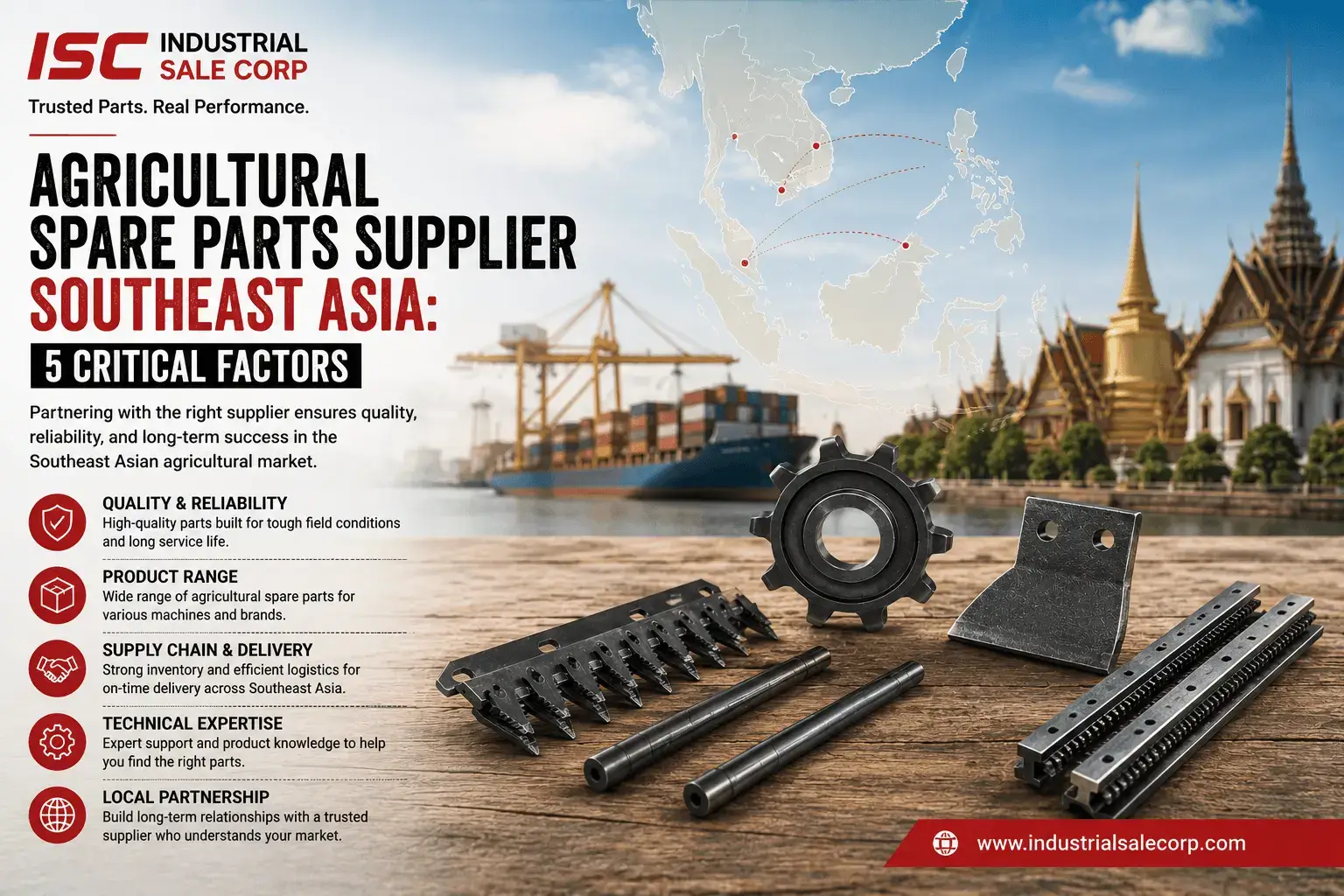
Rice combine harvesters, not cereal-crop machines, dominate the fleet across Vietnam, Thailand, Indonesia, and the Philippines — and that single difference reshapes what an agricultural spare parts supplier Southeast Asia distributors can rely on actually needs to get right.
📋 In This Guide
Why Rice Changes Everything
Demand across the region skews toward parts built for wet-field conditions and rice-specific threshing profiles rather than the cereal-crop setups common elsewhere. An agricultural spare parts supplier Southeast Asia distributors trust needs to understand that difference at the product level, not just at the shipping level.
That distinction shows up in small but costly ways. A rasp bar profile optimized for dry cereal straw will thresh rice stalks inconsistently, leaving grain loss that a farmer notices within the first field pass — and traces straight back to the distributor who supplied the part. Suppliers who forge specifically for the region’s wet-field conditions, rather than repackaging a generic cereal-crop catalog, are the ones distributors keep reordering from season after season. It’s a detail that rarely shows up in a spec sheet, but it’s often the single biggest factor separating a supplier a distributor trusts for years from one they quietly stop reordering from after the first bad season.
5 Factors That Separate Good Suppliers From Risky Ones
- Rice-specific part profiles — rasp bars and blades tuned for rice threshing differ from cereal-crop equivalents.
- Consistent container lead times to major regional ports, since seasonal harvest timing leaves little room for delay.
- Corrosion-resistant packaging for humid transit and storage conditions common across the region.
- Flexible order volumes that accommodate smaller regional distributors as well as large national buyers.
- Responsive after-sales support for warranty claims and part cross-referencing during peak season.
Regional Logistics: What to Expect
Shipping into Southeast Asian ports often means navigating a mix of major hub ports and smaller regional terminals with less predictable handling times. Suppliers experienced in the region build buffer time into quoted lead times and can advise distributors on the most reliable routing for their specific destination country.
Regional note: Rice threshing typically uses lower-impact rasp bar and blade profiles than cereal crops, to reduce grain cracking — worth confirming explicitly with any new supplier.
Vetting an Agricultural Spare Parts Supplier Southeast Asia Distributors Haven’t Worked With Before
New supplier relationships in this region carry more risk simply because distributors haven’t yet seen consistency across a full harvest season. Requesting a trial order of high-turnover items like rasp bars for combine harvesters before committing to a full container is a practical way to test a new relationship. It’s also worth asking directly how a prospective supplier has previously handled peak-season demand spikes, since harvest timing across Southeast Asia compresses into narrow windows that put real pressure on lead times.
FAQ
Which Southeast Asian countries import the most agricultural spare parts?
Vietnam, Thailand, Indonesia, and the Philippines are the largest markets, driven by extensive rice combine harvester fleets.
Are rice-specific rasp bars different from standard cereal rasp bars?
Yes — rice threshing typically uses lower-impact profiles to reduce grain cracking, which differs from standard cereal-crop rasp bar designs.
What container volumes work best for smaller regional distributors?
Many suppliers offer mixed-part container loads, allowing smaller distributors to order varied part types without committing to single-product container volumes.
Industrial Sales Corporation supplies forged agricultural parts including rice-specific rasp bars and blades to distributors across the region, with container planning support for both large and smaller regional orders.