
Quick Answer
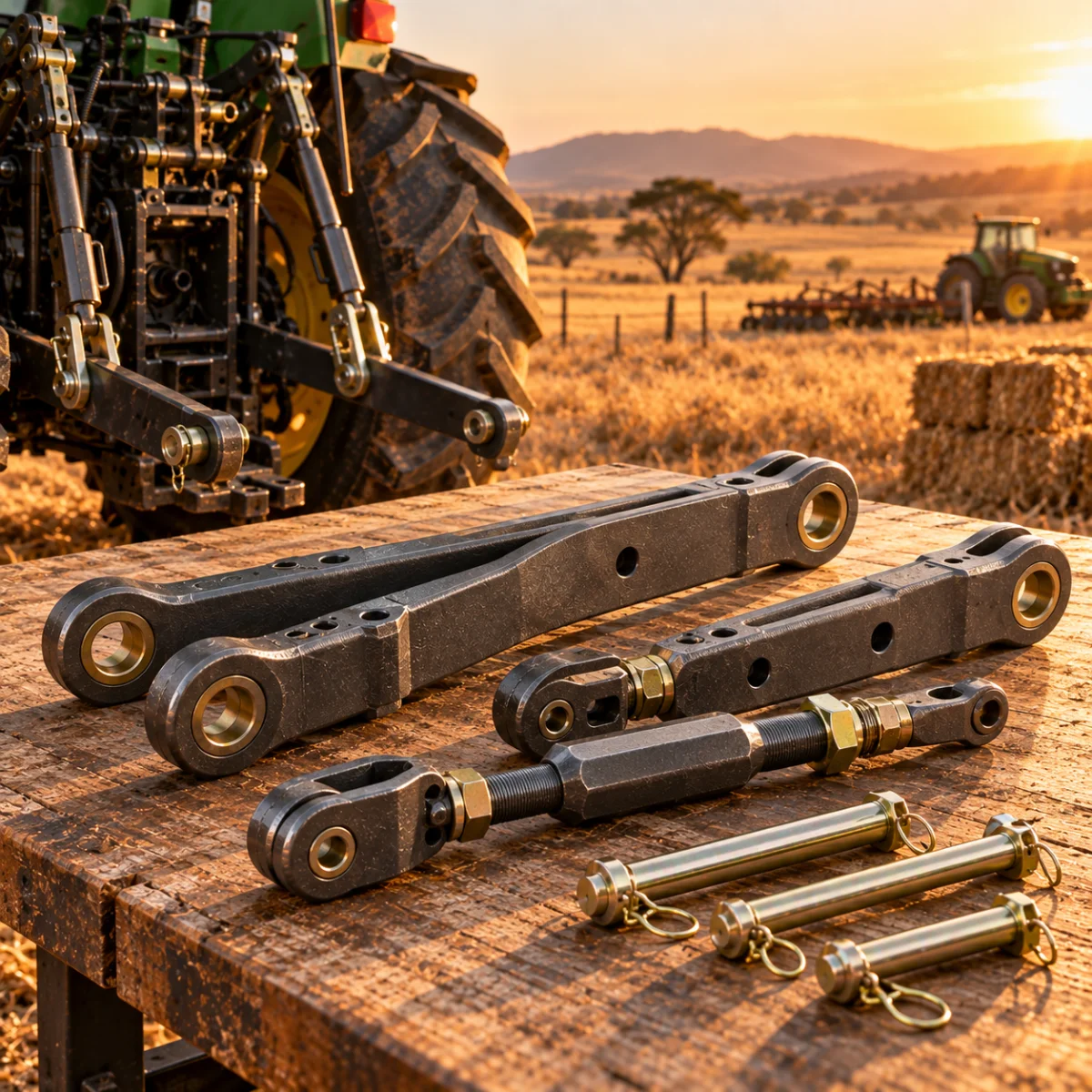
Looking for a reliable 3-point linkage parts supplier South Africa importers trust? Industrial Sales Corporation (ISC) forges Category 1 and Category 2 lower links, top links, lift arms, and linkage pins in India, built to OEM tolerances and shipped directly to South African ports with full mill certification.
South African farmers run some of the toughest conditions on the continent for 3-point linkage components — dry, abrasive soil in the Free State and Northern Cape, heavy clay in KwaZulu-Natal, and long seasonal hours on implements that never really stop moving. Linkage parts take the brunt of that stress every time an implement is hitched, lifted, or dropped into uneven ground. This guide covers what to check before choosing a supplier, and the five forged linkage parts most South African buyers reorder.
Why Forged Linkage Parts Matter in South African Conditions
A 3-point linkage system carries the full working load of mounted implements — ploughs, planters, boom sprayers, slashers — through just a handful of pivot points. When a lower link, top link, or lift arm is cast rather than forged, the grain structure of the metal is random and brittle under repeated shock loading. Forged components, by contrast, have a continuous grain flow that follows the part’s shape, giving them far higher fatigue resistance. For South African operations running long hours on rocky or compacted ground, that difference shows up directly in how often parts need replacing.
| Linkage Part | Typical Failure Point | Why Forging Helps |
|---|---|---|
| Lower Link Arms | Ball end wear, bending under load | Grain flow resists bending fatigue |
| Top Link Assembly | Thread wear, pin hole elongation | Hardened threads hold tolerance longer |
| Lift Arms | Cracking at the pivot boss | No internal voids to initiate cracks |
| Linkage Pins | Shearing, surface galling | Case hardening resists shear and wear |
| Stabilizer Links | Loosening, thread stripping | Consistent thread engagement over time |
5 Best Forged 3-Point Linkage Parts for South African Buyers
These are the linkage components South African distributors and workshops order most often from ISC, across both Category 1 (compact and mid-size tractors) and Category 2 (larger row-crop and general-purpose tractors).
1. Category 2 Lower Link Arms
Forged from medium-carbon alloy steel and heat-treated to resist bending under heavy implement loads. Available with ball ends, clevis ends, or quick-attach configurations to match Massey Ferguson, John Deere, and New Holland hitch geometry common across South African fleets.
2. Adjustable Top Links
Forged link bodies with machined threads for precise implement leveling. ISC supplies both mechanical and telescopic (quick-adjust) top links, sized to Category 1 and Category 2 mounting dimensions.
3. Lift Arms and Rock Shaft Arms
Forged lift arms transmit the hydraulic lift force from the rock shaft to the lower links. ISC manufactures these to OEM boss diameter and spline specifications so they bolt straight onto existing rock shafts without machining.
4. Linkage Pins and Lynch Pins
Case-hardened forged pins sized for Category 1 (22mm/28mm) and Category 2 (28mm/37mm) linkage points, supplied with matching lynch pins or hairpin clips for secure field attachment.
5. Stabilizer Links and Chains
Forged turnbuckle-style stabilizer links that limit side-to-side sway on mounted implements, critical for boom sprayers and planters working at speed across uneven South African fields.
Buyer’s Tip: Always confirm Category 1 vs Category 2 pin diameters before ordering. A linkage pin that’s 1-2mm undersized will wear out the link holes within a season, while an oversized pin won’t fit at all.
What to Check Before Choosing a Supplier
- Steel grade and heat treatment records. Ask for the material certificate, not just a verbal assurance.
- Forged, not cast. Cast linkage parts are cheaper but fail faster under repeated shock loading — ask directly how the part is manufactured.
- OEM dimensional cross-reference. A supplier who can match your implement’s exact part number saves fitment headaches.
- Experience shipping to South African ports. Durban and Cape Town import documentation differs from other regions — prior experience avoids delays.
- Sample order first. A trustworthy 3-point linkage parts supplier South Africa buyers can rely on long-term will support a small trial order before a full container booking.
Shipping to South Africa: What to Expect
Forged linkage parts from India typically ship via sea freight through Mumbai (Nhava Sheva) to Durban or Cape Town. Production runs 15-20 days for a standard order, with sea transit adding another 20-25 days. Most South African distributors plan for a 5-6 week door-to-door lead time, factoring in customs clearance at the destination port. ISC coordinates full export documentation, including bill of lading and certificate of origin, for every South Africa-bound shipment.
How ISC Manufactures 3-Point Linkage Parts
Industrial Sales Corporation has been forging agricultural parts in Ludhiana, Punjab since 1988. Every linkage component starts as hot-forged alloy steel, heat-treated to the hardness specification for its application, then CNC-machined to final tolerance. ISC has built a track record as a dependable 3-point linkage parts supplier South Africa distributors return to for repeat container orders, backed by documented quality control at every production stage.
Cost Advantage for South African Importers
Sourcing forged linkage parts directly from an Indian manufacturer, rather than through a European or local intermediary, typically delivers meaningful landed-cost savings even after freight, duty, and port handling are included. For high-turnover wear parts like linkage pins and lower links, that saving compounds significantly across a full season’s restocking volume.
Frequently Asked Questions
Q: What’s the difference between Category 1 and Category 2 linkage?
A: Category 1 fits compact to mid-size tractors (roughly 20-45kW) with smaller pin diameters; Category 2 fits larger tractors (45-90kW) with larger pins and link spacing. Check your tractor’s operator manual to confirm.
Q: Can ISC supply mixed Category 1/Category 2 linkage sets?
A: Yes, ISC manufactures convertible linkage components that adapt between categories for operations running mixed tractor fleets.
Q: What’s the minimum order quantity for South African shipments?
A: ISC supports both sample orders and full container loads — MOQ depends on the specific part, with better per-unit pricing at container volumes.
Q: Do the linkage parts come with a warranty?
A: ISC stands behind its forged parts with documented quality certification and material test reports for every production batch.
Q: How does ISC handle customs documentation for South Africa?
A: ISC prepares full export paperwork, including certificate of origin and bill of lading, coordinated with the buyer’s customs clearing agent at Durban or Cape Town.
Get a Quote on Forged Linkage Parts
As a 3-point linkage parts supplier South Africa workshops and distributors reorder from season after season, ISC ships forged Category 1 and Category 2 linkage components with full OEM cross-reference support. Get in touch for a quote or browse the full linkage parts range.