
European agricultural equipment distributors sourcing 3-point linkage parts face a recurring problem: local manufacturers quote long lead times for a category of parts that farms need replaced quickly, often mid-season. Finding a reliable 3-point linkage parts supplier Europe distributors can order from repeatedly, at forged quality, is what separates a one-off purchase from a dependable supply chain.
This guide covers the difference between Category 1 and Category 2 linkage parts, what to check before choosing a supplier, and how forged parts compare to cast alternatives for this wear category.
What Are 3-Point Linkage Parts and Why Category Matters
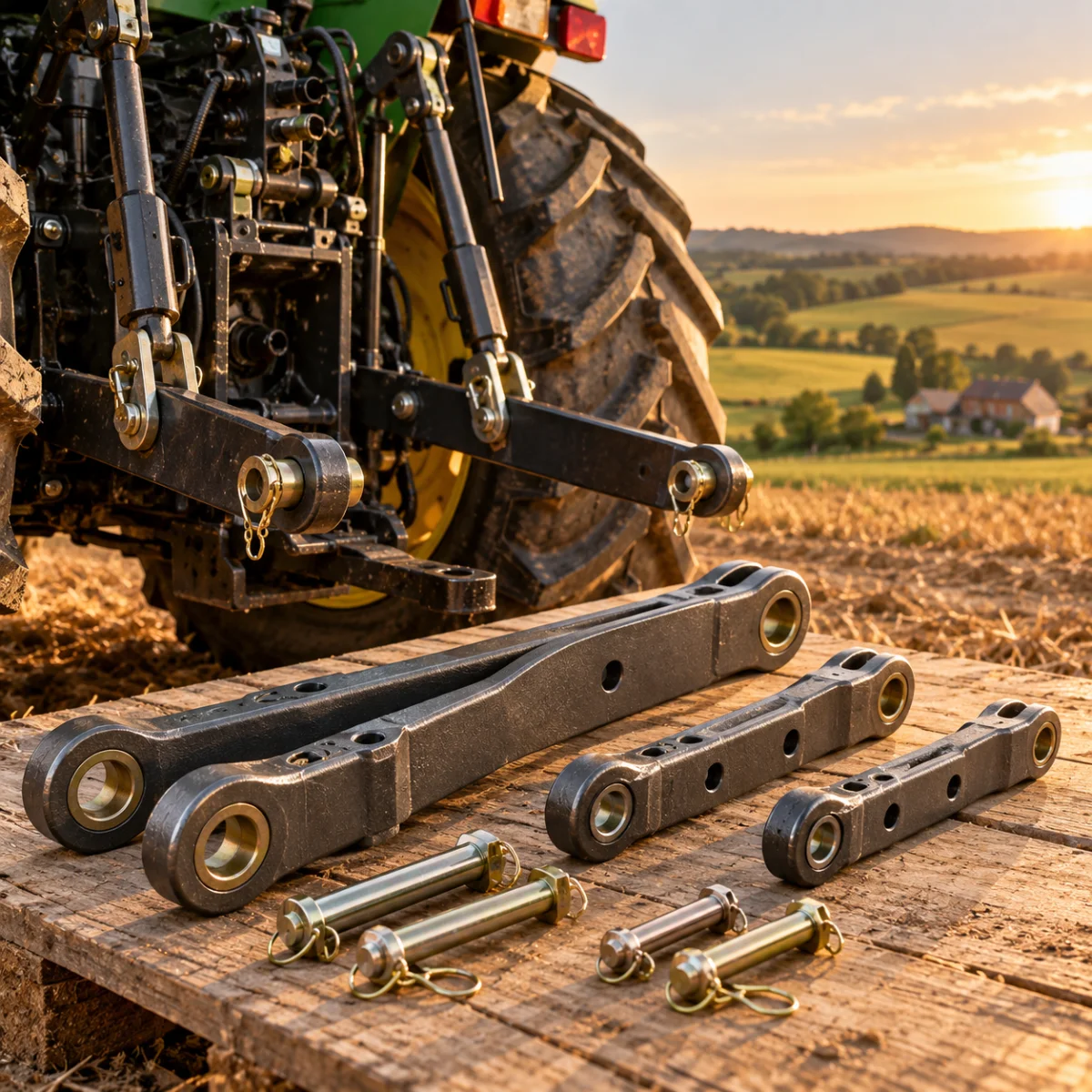
The three-point linkage (or hitch) is the standard mounting system connecting a tractor to towed or mounted implements — ploughs, cultivators, mowers, and more. It consists of two lower lift arms and one upper link (the top link), along with pins, ball joints, stabilizer bars, and lift rods that wear down with use.
Linkage parts are standardized into categories under the ISO 730 three-point linkage standard, primarily by pin diameter and arm spacing — the same specification any 3-point linkage parts supplier Europe distributors work with should be building to:
| Category | Typical Tractor HP | Lower Pin Diameter |
|---|---|---|
| Category 1 | Up to ~55 HP | ~22 mm |
| Category 2 | ~55-120 HP | ~28 mm |
Ordering the wrong category is the most common and costly mistake European distributors make when importing linkage parts — always confirm tractor make, model, and HP before placing a bulk order.
Why European Buyers Are Looking Beyond Local Suppliers
Three factors are pushing European distributors toward an Indian 3-point linkage parts supplier instead of local stockists for this part category:
- Cost per unit. Forged steel parts are labor- and energy-intensive to produce. India’s forging sector operates at a structurally lower cost base than most EU manufacturing without compromising steel grade.
- Breadth of catalog. A dedicated forging exporter can supply the full linkage assembly — lower lift arms, top links, stabilizers, pins, and ball joints — rather than forcing distributors to source from multiple local workshops.
- Capacity for bulk orders. A distributor restocking ahead of the spring and autumn tillage seasons needs a supplier who can commit to a container-load order on a fixed timeline.
What to Check Before Choosing a 3-Point Linkage Parts Supplier Europe Relies On
Not every exporter offering “3 point linkage parts” delivers the same quality. Before committing, European buyers should verify:
- Exact category confirmation. A credible supplier asks for tractor make, model, and HP before quoting — not just “Category 1 or 2.”
- Steel grade and hardness. Ask for the exact steel specification and request a material test certificate, not just a verbal assurance.
- Forging process, not casting. Forged linkage parts have a denser grain structure than cast ones, giving better fatigue resistance under repeated load cycles.
- CE and export documentation. A supplier exporting regularly to the EU should understand standard import documentation and HS code classification.
- Sample order before bulk commitment. Any established exporter should be willing to ship a small sample batch before a full container order.
Practical tip: ask for the supplier’s cross-reference chart mapping their part numbers to major European tractor brands (Massey Ferguson, Case IH, New Holland, Fendt, Deutz-Fahr). A supplier without one is likely unable to confirm exact fitment before shipping.
Shipping and Lead Times from India to Europe
A typical India-to-Europe shipment for forged 3-point linkage parts follows the same pattern as other forged agricultural wear parts:
- Production time: 15-25 days for a standard bulk order.
- Transit time by sea: 20-30 days to major European ports — Rotterdam, Hamburg, and Antwerp are the most common entry points.
- Total lead time: Most buyers should plan for 5-7 weeks door-to-door from order confirmation to arrival, factoring in customs clearance.
How ISC Manufactures 3-Point Linkage Parts
Industrial Sales Corporation (ISC) forges 3-point linkage parts — lift arms, top links, stabilizer bars, and pins — at its Ludhiana, Punjab facility using hot-forged alloy steel. Every batch is produced against documented steel specifications, and parts are cross-referenced against major European tractor brands so a 3-point linkage parts supplier Europe distributors can rely on repeat-order after repeat-order, with confidence in fitment.
ISC has been manufacturing and exporting agricultural forged parts since 1988, with an established export process covering documentation, container loading, and freight coordination for European-bound shipments.
Cost Advantage: What European Buyers Typically Save
Distributors sourcing forged 3-point linkage parts directly from an Indian manufacturer rather than through a European intermediary typically see meaningful landed-cost savings even after freight, duty, and customs clearance are factored in — because the per-unit manufacturing cost differential is large enough to absorb those additional costs and still undercut EU-sourced or re-distributed pricing.
Red Flags to Watch For When Evaluating Suppliers
- No willingness to share a material test certificate. A genuine manufacturer tests every production batch and keeps records.
- Vague category confirmation. “It should fit most tractors” is a red flag — linkage parts are precisely categorized for a reason.
- Unusually fast quoted lead times with no production detail. Forging and heat-treating steel takes time.
- Reluctance to send a small sample first. This is the lowest-risk way to validate a new supplier relationship.
This post is part of ISC’s ongoing content covering agricultural wear parts for international buyers — see the full blog archive for related guides, including the Rasp Bars Supplier Europe guide.
Frequently Asked Questions
How do I know if I need Category 1 or Category 2 linkage parts?
Check your tractor’s HP rating and existing linkage pin diameter. Tractors up to ~55 HP typically use Category 1 (~22mm pins); 55-120 HP tractors typically use Category 2 (~28mm pins). When in doubt, measure the existing lower lift arm pin diameter directly.
Are forged linkage parts better than cast ones?
Yes, for this application. Forging compresses and aligns the steel’s grain structure, giving better fatigue resistance under the repeated load cycles linkage parts experience.
What’s a realistic minimum order quantity for importing from India?
Most exporters can accommodate a sample order of a few dozen pieces before scaling to a full container load.
Do 3-point linkage parts need CE marking?
As standalone replacement parts, they’re generally not subject to CE marking themselves, but your supplier should understand standard EU import documentation and HS code classification.
How often do linkage parts need replacing?
Pins and ball joints typically wear faster than the arms themselves — inspect for excessive play or elongated pin holes each season.
Get a Quote
ISC supplies forged 3-point linkage parts to distributors and importers across Europe, with cross-reference support for major tractor brands. Get in touch for a quote or browse the full product range.