
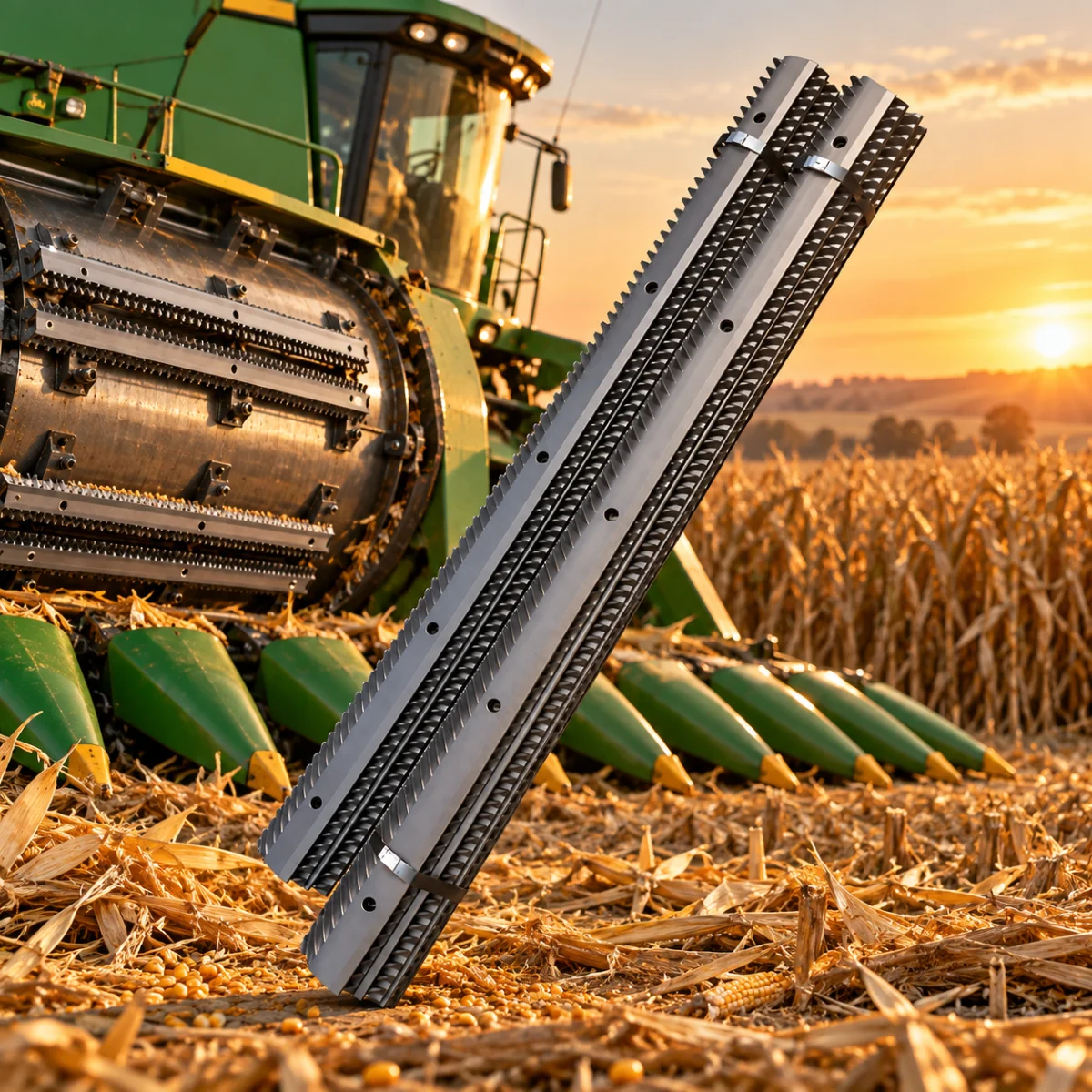
If you’re sourcing combine harvester wear parts for South African farms, you already know the market looks different from Europe. South African operations mostly run John Deere and Case IH combines, harvest maize rather than wheat, and are concentrated in two commercial belts — the Free State and the Western Cape. Finding a rasp bars supplier South Africa distributors can depend on, at a workable price and lead time, usually means looking at established forging exporters like India rather than waiting on limited local stock.
This guide covers what rasp bars do on a maize harvester, how to cross-reference John Deere and Case IH part numbers, what to check before committing to a supplier, and what a shipment from India to Durban actually looks like in practice.
Why Maize Harvesting Wears Rasp Bars Differently
Rasp bars line the threshing drum of a combine harvester, gripping and rubbing crop material against the concave to separate grain from stalk. On a maize harvester, the bars handle thicker, drier stalk material than a wheat or barley operation does — which means a different wear pattern and, often, a shorter replacement interval during a long harvest season across the Free State’s maize belt.
Worn rasp bars on a maize harvester show up as increased kernel damage, higher grain loss over the sieves, and more fuel burned per tonne threshed. Most commercial maize operations in South Africa replace rasp bars every one to two seasons, depending on stone content in the field and total threshing hours — which makes a dependable, repeat-order supplier more valuable than a one-time cheap batch.
John Deere and Case IH: The Two Brands That Matter Most
Unlike Europe’s more fragmented brand landscape, South African commercial farms are concentrated around two combine brands:
- John Deere. The dominant brand across Free State and Mpumalanga grain farms. Rasp bar profiles vary by drum model, so a supplier needs to confirm the exact machine model, not just “John Deere,” before cross-referencing.
- Case IH. The second-most common brand, particularly on larger commercial operations. Case IH drums use a different bar geometry from John Deere, so cross-reference accuracy matters just as much here.
A rasp bars supplier South Africa buyers can trust should be able to confirm a forged equivalent against either brand’s OEM part number within a day, not after weeks of back-and-forth.
What to Check Before Choosing an Indian Rasp Bar Supplier
Not every rasp bars supplier South Africa buyers come across delivers the same quality. Before placing a bulk order, South African buyers should verify:
- Steel grade and hardness. Ask for the exact steel specification (commonly boron or alloy steel in the 45-55 HRC range) and a material test certificate — not just a verbal assurance.
- Forging process, not casting. Forged rasp bars have a denser grain structure than cast ones, giving better impact resistance under the high-stone-content conditions common in parts of the Free State.
- John Deere / Case IH cross-reference documentation. A credible supplier maintains a cross-reference chart mapping their part numbers to both brands’ OEM numbers, removing fitment guesswork.
- Experience shipping to Durban. A supplier that regularly exports to South Africa understands the paperwork, customs process, and realistic transit timelines — a first-time India-to-South Africa shipper often underestimates this.
- Sample order before bulk commitment. Any established exporter should ship a small sample batch before a full container order — the lowest-risk way to validate quality.
Shipping and Lead Times from India to Durban
For any rasp bars supplier South Africa distributors are vetting, realistic lead-time expectations matter as much as price. A typical India-to-South Africa shipment for forged agricultural parts looks like this:
- Production time: 15–25 days for a standard bulk order, depending on quantity and whether new tooling is required.
- Port of origin: Most Indian forging exporters route through Mumbai (Nhava Sheva) or Chennai.
- Transit time by sea: 18–25 days to Durban, South Africa’s primary port of entry for agricultural machinery parts.
- Total lead time: Most buyers should plan for 5–6 weeks door-to-door from order confirmation to arrival at a South African warehouse, factoring in customs clearance.
Practical tip: if you’re restocking ahead of the maize harvest, place your order at least 8 weeks before you need stock on the shelf — this buffers against seasonal port congestion at Durban, which is common in the months leading into harvest.
Durban port congestion trends are tracked publicly by Transnet National Ports Authority, a useful reference point for any rasp bars supplier South Africa distributors are evaluating for consistent shipping performance.
A rasp bars supplier South Africa distributors restock from every season should be able to give you a realistic, documented lead time upfront — not an optimistic one that slips once the order is placed.
How ISC Manufactures Rasp Bars
As a rasp bars supplier South Africa buyers have worked with since the 1980s, Industrial Sales Corporation (ISC) forges rasp bars at its Ludhiana, Punjab facility using hot-forged alloy steel, finished to match the wear-resistance profile combine harvester drums need under continuous threshing load. Every batch is produced against documented steel specifications, and parts are cross-referenced against major John Deere and Case IH part numbers South African buyers typically request.
ISC has been manufacturing and exporting agricultural forged parts since 1988, with an established export process covering documentation, container loading, and freight coordination for South Africa-bound shipments — removing the logistics uncertainty that’s often the biggest barrier for a first-time India-sourced order.
Cost Advantage: What South African Buyers Typically Save
While exact savings depend on volume and the specific OEM cross-reference, distributors sourcing forged rasp bars directly from an Indian manufacturer rather than through a limited local supplier typically see meaningful landed-cost savings even after freight, duty, and customs clearance are factored in. For a high-turnover wear part like rasp bars, that difference compounds significantly across a full maize harvest season’s restocking volume.
Red Flags to Watch For When Evaluating Suppliers
Because rasp bars look fairly simple from the outside, it’s easy to underestimate how much manufacturing quality varies between exporters. A few warning signs worth taking seriously before placing a bulk order:
- No willingness to share a material test certificate. A genuine manufacturer tests every production batch and keeps records — vagueness here is a signal to look elsewhere.
- Unusually fast quoted lead times with no production detail. Forging and heat-treating steel takes time. A supplier promising a full container in under two weeks, with no explanation, is worth questioning.
- No cross-reference chart, only “it should fit.” Ambiguity about exact fitment is one of the most common reasons buyers end up with a container of parts that don’t match their John Deere or Case IH machines.
- Reluctance to send a small sample first. This is the lowest-risk way to validate a new supplier relationship.
These checks take an extra week or two upfront, but they’re far cheaper than discovering a fitment or hardness problem after a container has already cleared Durban customs and been distributed to your own customers.
This post is part of ISC’s ongoing content covering combine harvester wear parts for international buyers — see the full blog archive for related guides, including the Rasp Bars Supplier Europe guide for buyers comparing sourcing regions.
Frequently Asked Questions
How do I know which rasp bar fits my John Deere or Case IH combine?
Most suppliers maintain an OEM cross-reference chart. Provide your machine’s make, model, and the OEM part number from your current (worn) rasp bar, and a supplier experienced in these brands should confirm the matching forged equivalent within a day.
Are forged rasp bars better than cast ones for maize harvesting?
Yes. Forging compresses and aligns the steel’s grain structure, giving better impact resistance under the thicker stalk material and stone content common in South African maize fields.
What’s a realistic minimum order quantity for importing from India to South Africa?
This varies by supplier, but most exporters can accommodate a sample order of a few dozen pieces before scaling to a full container load.
How long does shipping from India to Durban typically take?
Most buyers should plan for 5-6 weeks door-to-door from order confirmation to arrival, including customs clearance.
How often should rasp bars be replaced on a maize harvester?
Typically every one to two harvest seasons, depending on stone content and total threshing hours — inspect for flattened ridges or rounded leading edges at the start of each season.
Get a Quote
As the rasp bars supplier South Africa distributors return to season after season, ISC supplies forged rasp bars with John Deere and Case IH cross-reference support and documented steel specifications for every batch. Get in touch for a quote or browse the full RASP Bars product range.